90% of software professionals now use AI at work. Only 24% trust its output “a lot” or “a great deal”, and 30% trust it “a little” or “not at all”.
That gap between adoption and trust is the single most useful fact about AI in software development right now, because almost every problem engineering leaders are currently firefighting sits inside it.
Google’s 2025 DORA report, drawn from nearly 5,000 technology professionals and 100+ hours of qualitative interviews, put adoption at 90%, up 14 points in a year, with a median of two hours a day spent working alongside AI tools. More than 80% said it improved their productivity.
Adoption of AI in software development is settled. What is not settled is how teams build around it.
The organisations getting value out of AI in software development are not the ones generating the most code. They are the ones that built something for that code to be checked.
From Autocomplete to an AI Coding Agentic System
The change worth paying attention to is not that models write better code. It is that the unit of work changed, and an AI coding agentic system is what changed it.
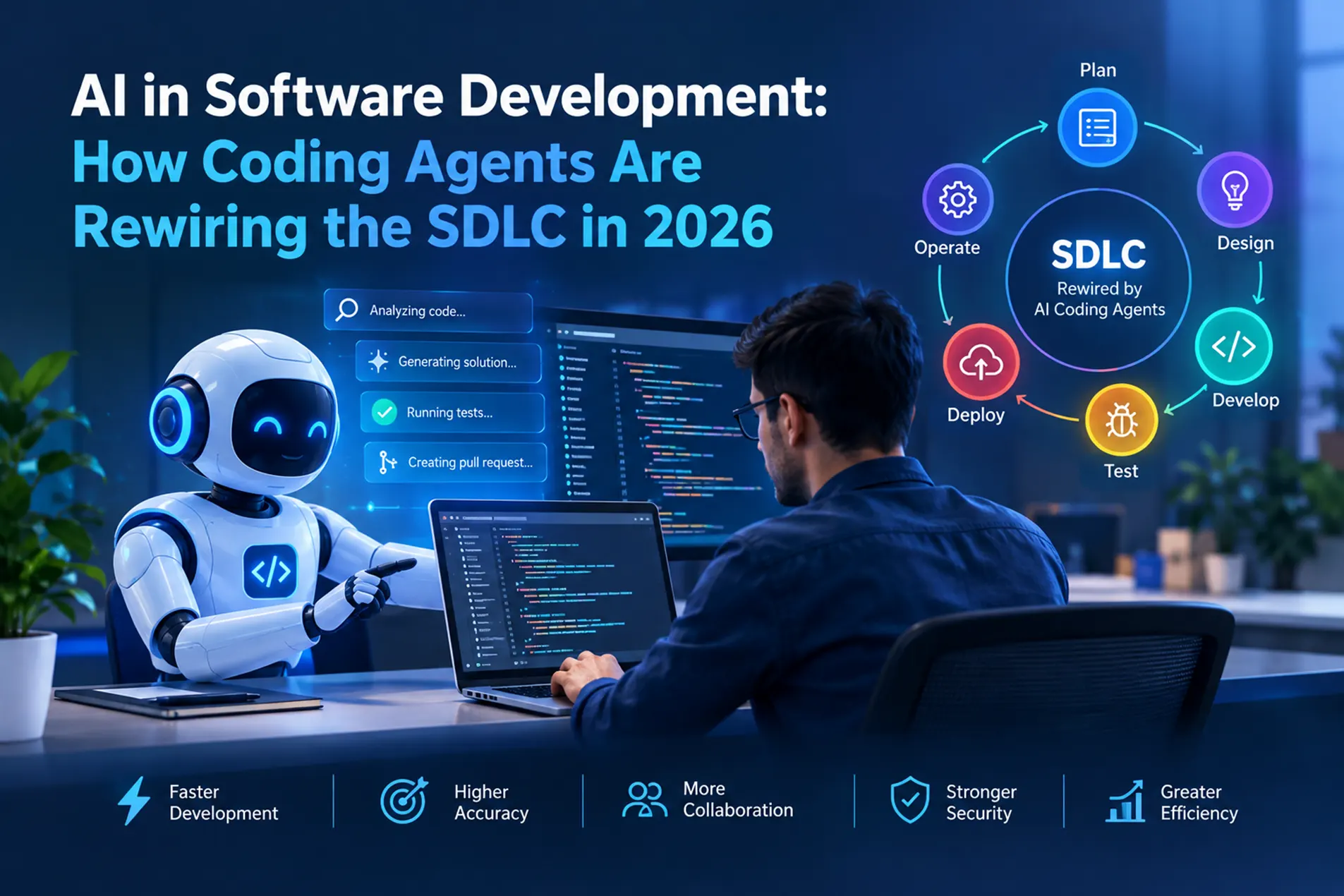
This is the shift that separates 2026 from 2024 in AI in software development. A code assistant completes the line you are typing. An AI coding agentic system takes a ticket, reads the repository, plans a sequence of steps, edits several files, runs the test suite, reads the failures, and opens a pull request.
Tools including GitHub Copilot, Cursor, Claude Code, Amazon Q Developer, and GitLab Duo now ship this loop as a product feature rather than a research demo.
The distinction matters commercially. An assistant makes an engineer faster inside a task. An AI coding agentic system removes the task from the engineer’s queue and replaces it with a review.
That is a different operating model, a different cost structure and a different risk profile, which is why a serious custom software development company treats agent rollout as a process change rather than a licence purchase.
The agent pattern is still early. Stack Overflow found 52% of developers either do not use agents or stay with simpler tools, and daily agent use sits at 14%.
Tooling is arriving faster than the operating discipline around it, which is the honest summary of AI in software development heading into next year.
AI in Software Development Life Cycle: Stage by Stage
Most coverage of AI in software development life cycle work stops at the coding stage, which is where the least leverage actually sits. Here is where teams delivering software development services at scale are seeing returns.
Requirements and discovery
The earliest use of AI in software development life cycle work is analytical, not generative.
Models cluster support tickets, interview transcripts, and competitor feature sets into candidate requirements, then generate acceptance criteria and edge cases a human missed. The output is a draft for a business analyst to cut, not a specification to hand to engineers.
Design and architecture
Agents generate architecture options against stated constraints, draft data models and produce first-pass threat models. Useful as an AI-assisted checklist against blind spots, and one of the cheapest wins in the AI in software development life cycle. Not a substitute for an architect who owns the decision.
Build
The most visible stage: scaffolding, boilerplate, migrations, refactors, test doubles. Modern models produce syntactically correct code close to 100% of the time. Correctness of intent is a separate question, and it is the one that decides whether AI in software development saves money or moves it.
Testing and QA
The strongest return from AI in automation is anywhere in the lifecycle. Agents generate unit and integration coverage for existing code, write Playwright end-to-end specs from a user story, triage flaky tests and reproduce bug reports. Test generation is verifiable by running it, which is exactly why this form of AI in automation outperforms most others.
Deployment and operations
Agents draft infrastructure-as-code, propose pipeline fixes, summarise incidents from logs and traces and suggest rollbacks. Read-only analysis is safe, and it is where AI in automation earns trust fastest. Write access to production is a governance decision, not an engineering one.
Maintenance and modernisation
Legacy comprehension is quietly the biggest win in AI in software development life cycle terms. Explaining a 200,000-line codebase nobody has owned for six years, mapping its dependencies and drafting a migration plan used to take a quarter. It now takes weeks, and it is the work most often handed to an external custom software development company in the first place.
The same lifecycle, three different pressure points
The stages are constant. Where AI in software development pays back depends on what you ship.
- Web builds. A website development company gains most from AI in software development in component scaffolding, accessibility fixes, and content-driven page generation, and loses most to client-side security defects. For a website development company, front-end speed is easy; front-end safety is not.
- Mobile builds. Firms selling mobile app development services gain most in cross-platform parity work, localisation and crash triage, and carry release-cycle risk when generated code reaches store review unscanned. Mobile app development services teams feel a bad merge one full release cycle later than a web team does.
- Enterprise platforms. For a custom software development company handling ERP, logistics or fintech systems, the return concentrates in legacy comprehension, integration mapping, and regression coverage, where AI in automation removes the slowest manual steps without touching business rules.
A custom build platform with AI integration adds a fourth pressure point: the model itself becomes a runtime dependency with its own cost and failure modes.
The Cost Nobody Puts in the Business Case
Three findings from 2025 and 2026 research belong in every rollout plan.
Security has not kept pace.
Veracode’s 2026 GenAI Code Security Report found AI-generated code passed security checks 56% of the time, effectively flat against 55% a year earlier. Roughly 44% of generation tasks introduced a risky vulnerability. Performance varies sharply by weakness class: 83% pass on SQL injection, but 15% on cross-site scripting and 12% on log injection.
Syntax is solved. Security is not.
Models now write syntactically correct code almost 100% of the time. They write secure code 56% of the time. Those two numbers are not converging.
Perceived speed is not measured speed.
METR’s randomised controlled trial put 16 experienced open-source developers across 246 real issues on their own repositories, projects averaging 22,000+ GitHub stars and over a million lines of code, where they had contributed for years.
They forecast AI would make them 24% faster. Afterwards, they still believed it had made them 20% faster. They were 19% slower.
A small sample, but a controlled one, on exactly the kind of mature codebase most enterprise work happens in.
Review becomes the bottleneck.
Stack Overflow found 45% of developers say debugging AI-generated code takes longer than expected. Generation capacity is now effectively free; review capacity is not. Teams that buy the first without funding the second move the queue rather than clear it.
DORA’s own framing is the one to internalise: AI is an amplifier. Its 2025 data shows AI adoption now correlating with higher software delivery throughput, while still carrying a negative relationship with delivery stability, speed exposing weaknesses downstream rather than creating them.
Strong version control, small batches, fast feedback, and clear ownership get amplified. So does the absence of them.
Five Rules That Separate Working Rollouts From Expensive Ones
Generation capacity is free. Review capacity is the budget line nobody writes down, in an in-house team or in a contract for software development services.
1. Make the agent’s work reviewable. Small, scoped pull requests with a written plan attached. An AI coding agentic system that opens a 2,000-line PR has moved work, not removed it.
2. Put the gates in the pipeline, not in the reviewer’s head. SAST, dependency scanning, secret detection, and coverage thresholds run automatically before a human looks at AI-generated output.
3. Start where output is verifiable. Test generation, documentation, migrations, and refactors carry a pass/fail signal, which is why AI in automation succeeds there first. Greenfield business logic does not.
4. Measure outcomes, not activity. Lines accepted and AI suggestions used prove nothing. Lead time, change failure rate, and rework rate do.
5. Keep accountability human. A named engineer owns every merged change. “The agent wrote it” is not an answer in a post-incident review or an audit.
What Changes When You Buy Development
The buying question has shifted. It is no longer whether a vendor uses AI in software development; every website development company and platform builder now does. It is whether they can show you the guardrails.
Ask any partner offering software development services three things: which lifecycle stages their agents touch, what runs automatically before a human reviews, and who signs off on merged output.
A vendor billing purely by the hour has little incentive to answer the first honestly, which is worth remembering when comparing quotes for software development services against each other.
Web, mobile and platform work diverge
The right questions about AI in software development differ by delivery model, and a single generic vendor answer should be treated as a red flag.
SolveByte writes evaluation sets before prompts and model inference cost per active user before the build starts, so a custom build platform with AI integration carries known unit economics rather than a demo that becomes expensive at scale.
Where This Goes Next
Three shifts in AI in software development look durable through 2027.
Specification becomes the primary artefact. When AI makes implementation cheap, the written definition of correct behaviour is where value concentrates, and requirement quality becomes the real constraint on delivery speed across the software development life cycle.
Team shape changes before headcount does. Fewer engineers writing first drafts, more reviewing and specifying. Junior pathways need deliberate redesign, because the tasks juniors learned on are the tasks agents now take.
Verification tooling becomes the differentiator. As generation commoditises, the edge in AI in software development moves to whoever holds the strongest evaluation, testing, and security infrastructure around the model, increasingly how a custom software development company wins competitive work.
Final Thought
Every major shift in this industry has been sold as a way to write more code faster. Very few of them were.
The compiler did not make programming easier; it moved the hard part from instructions to logic. Version control did not stop people breaking the build; it made breakage recoverable. Continuous integration did not remove bugs; it moved their discovery from the customer to the pipeline. In each case, the tool was adopted almost universally, and the teams that benefited were the ones who redesigned their process around it rather than bolting it onto the old one.
The teams that will look competent in 2028 are not the ones who adopted earliest. They are the ones who, in 2026, were honest enough to measure what AI actually did to their lead time and their change failure rate, rather than counting accepted suggestions and calling it productivity.
Frequently Asked Questions
AI in software development means applying machine learning models across the build lifecycle: generating and reviewing code, writing tests, drafting documentation, analysing logs and automating pipeline work. Adoption reached 90% of software professionals in 2025, though only 24% express strong trust in the output.
An AI coding agentic system takes a task, plans multiple steps, edits several files, runs tests, reads failures, and opens a pull request. Unlike an assistant that completes single lines, it removes the task from a developer’s queue and replaces it with a review.
Not automatically. A METR randomised trial found experienced developers were 19% slower with AI on familiar codebases while estimating they were 20% faster. Gains are real in test generation, boilerplate and legacy comprehension, and unreliable on complex logic in code a developer already knows.
Often not. Veracode’s 2026 report found AI-generated code passed security checks 56% of the time, with roughly 44% of tasks introducing a vulnerability. Cross-site scripting passed just 15%. Automated scanning inside the pipeline is mandatory, not optional.
Testing, documentation, refactoring and legacy modernisation, because output is verifiable by running it. Requirements analysis and architecture benefit as a first-draft aid. Greenfield business logic benefits least, since no automatic signal tells you the result is wrong.
No current evidence supports replacement. Generation capacity has grown far faster than verification capacity, so review, specification and architecture work is expanding. Roles are shifting toward judgement rather than typing, and accountability for merged code stays with a named human engineer.
Start where output is verifiable: test coverage, documentation, migrations. Add automated security and quality gates before expanding. Measure lead time, change failure rate and rework rather than suggestion-acceptance rates. Expand only into stages your review capacity can absorb.
Ask which lifecycle stages their agents touch, what scanning runs automatically before human review, who signs off on merged output and how they measure rework. A partner who cannot answer specifically is passing the verification cost to you.
Meaningful automation exists in testing, code review triage, documentation, dependency updates and incident summarisation. Full autonomy across the lifecycle does not exist in production at enterprise scale. Gartner expects 40% of enterprise applications to embed task-specific agents by the end of 2026.
It reduces build hours and can raise review, security and rework hours. Net saving depends on whether quality gates are automated. Teams adding generation capacity without funding verification typically move cost rather than remove it.

Recent Blogs
Categories